Armageddon Politics: Christian Nationalism and the Department of War’s Dystopian View of War with Iran
Christian Nationalism and the Erosion of Constitutional Governance
The Muslim Public Affairs Council (MPAC) warns against the growing influence of Christian nationalist rhetoric shaping the political narrative around U.S. confrontation with Iran and broader Middle East policy.
Christian nationalism is a political ideology that argues the United States was founded as a Christian nation and should be governed according to a particular interpretation of Christian beliefs and values. This separation of religion from governance has been foundational to American values and Democracy as demonstrated by this principle being enshrined as a core tenet of the First Amendment in 1791. However, in recent years, Christian nationalism has increasingly merged with segments of the evangelical political movement; this is where political authority and foreign policy are framed through apocalyptic theology and religious civilizational conflict. Many Christians argue that Christian nationalism is a distortion of the values and ideals that Jesus actually taught.
Recent reporting indicates that a U.S. combat-unit commander reportedly told troops that the conflict with Iran was part of “God’s divine plan,” referencing the Book of Revelation and describing President Donald Trump as “divinely chosen” to trigger events associated with Armageddon. According to a complaint submitted to the Military Religious Freedom Foundation, troops were encouraged to interpret the conflict through a biblical lens rather than a strategic one.
These concerns are compounded by the worldview promoted by Secretary of War (Defense) Pete Hegseth. In his book American Crusade, Hegseth frames modern geopolitical conflicts as a civilizational struggle and praises the medieval Crusades as a necessary effort to push back against Islam. He has publicly embraced Crusader symbolism, including tattoos associated with the Crusader movement such as “Deus Vult” a Latin crusader phrase that translates to “God wills it” and one that says Kafir, meaning “disbeliever,” reinforcing rhetoric portraying contemporary geopolitical conflicts as a continuation of historic religious wars.
SECTION 1—War Framed as Divine Will
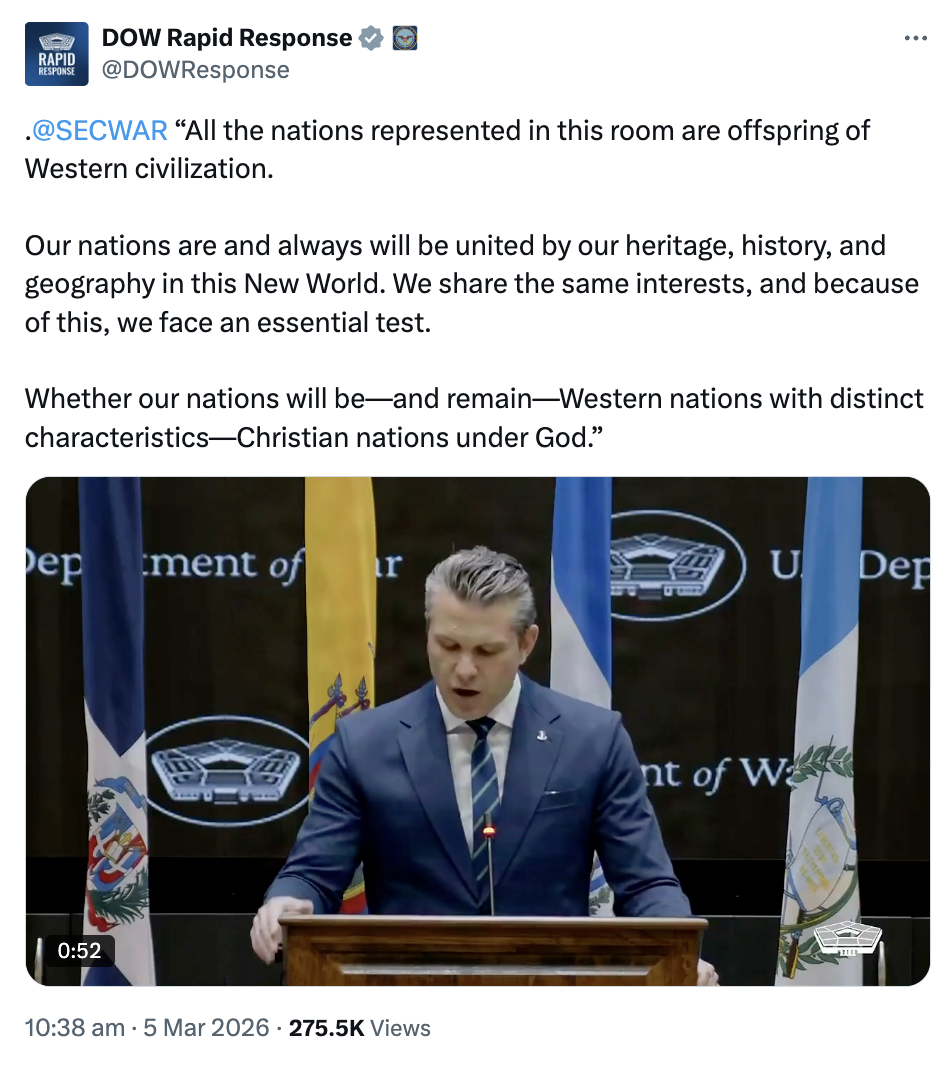
An X post from the official Department of War rapid response account just this week.
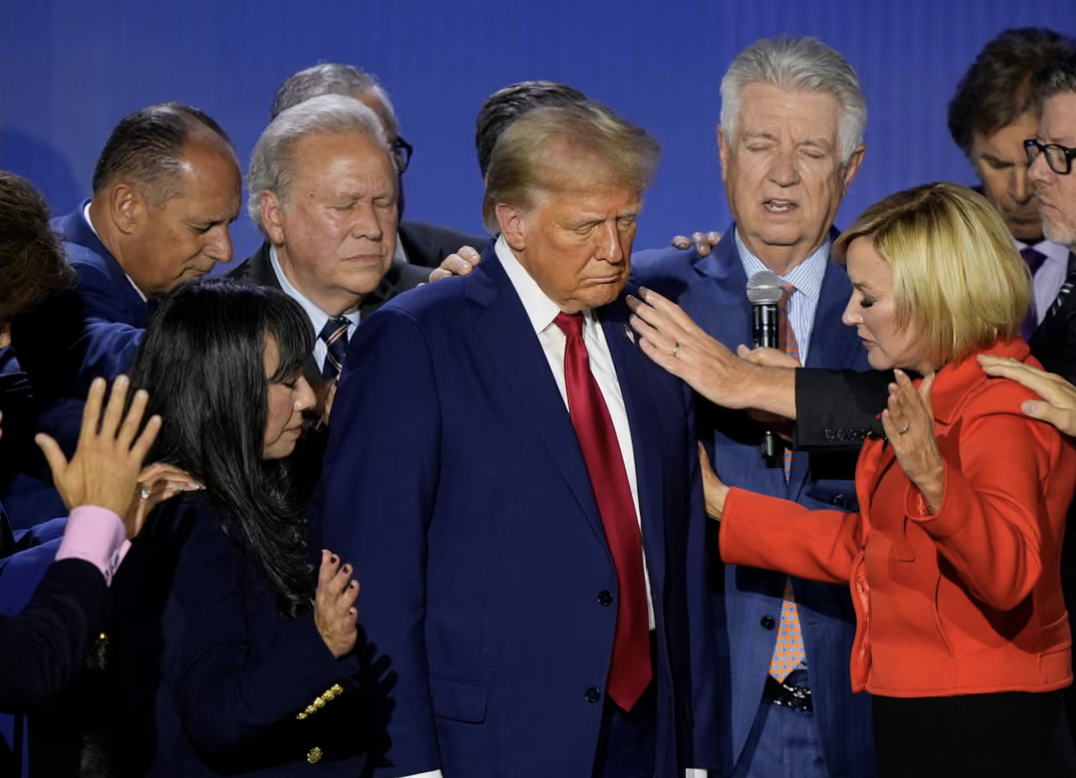
This ideological framing is reinforced by Trump’s allyship with a segment of the evangelical movement, which openly presents political authority as divinely ordained. Trump’s longtime spiritual advisor, multimillionaire televangelist Paula White-Cain, has played a central role in organizing Christian Fundamentalist access to the White House and has led prayer sessions with the president in the Oval Office and during policy discussions.
White has frequently framed political opposition in spiritual warfare terms and publicly prayed in 2019 that Trump would overcome “every strategy from hell,” language that casts political conflict in explicitly religious and apocalyptic terms.
The integration of such religious actors into policymaking structures should be deeply concerning to any American who values the rule of law or civil liberties. Scholars and advocates continue to warn the public that Christian nationalist ideology is gaining influence within governing institutions and shaping policy narratives that privilege one religious worldview over others.
SECTION 2—Protecting the Establishment Clause in the First Amendment
The First Amendment to the United States Constitution protects both the free exercise of religion and prohibits the government from establishing any religion. Its Establishment Clause states that Congress shall make no law respecting an establishment of religion—a principle widely understood to require a separation between church and state in public governance. This framework ensures that individuals are free to practice their faith while preventing government institutions from privileging one religious doctrine over others.
This framework is actively deteriorating. Several prominent political figures within the MAGA movement have echoed similar rhetoric portraying global politics as a religious or civilizational conflict with Islam. Figures including Mike Huckabee, Lindsey Graham, Mike Johnson, Keith Self, Tommy Tuberville, Brandon Gill, Randy Fine amongst many others in government have repeatedly advanced narratives that conflate national security policy with religious ideology and promote hostility toward Muslim communities.
The United States is a pluralistic democracy founded on the principles of religious freedom and the separation of church and state. Decisions that risk military conflict must be guided by constitutional governance, democratic accountability, and responsible national security strategy, not by religious nationalism or rhetoric that frames modern geopolitics as a crusade.
SECTION 3—The Hypocrisy of Islamification Claims
There is a striking irony in this rhetoric. For years, a sect of the conservative movement has warned that Muslim communities seek to “Islamify” American institutions or impose “sharia law” on U.S. governance. Yet these same figures openly advocate for policies and political frameworks that explicitly privilege Christianity in public life. Christian nationalist discourse frequently calls for the United States to be governed as a “Christian nation,” promotes religious tests in political rhetoric, and frames foreign policy through biblical prophecy and spiritual warfare. While accusations of “Islamification” have long been used to stoke fear of Muslim participation in public life, the increasing normalization of Christian nationalist ideology risks the fusing of church and state rather than its separation.
MPAC calls on policymakers to reject narratives that portray conflicts in the Middle East as religious wars and to reaffirm that U.S. foreign policy must reflect the constitutional values and pluralistic principles that define our nation.
SECTION 4—Recommendations to Congress, Civil Society, and the American People
MPAC recommends the following to hold our government responsible for ensuring our constitution is protected, and our policies are consistent with the Establishment Clause:
The House and Senate Armed Services Committees must subpoena and question the Secretary of War on the Department's use of religious rhetoric, symbolism, and ideology in the execution of war plans and briefings to generals and soldiers.
Members of Congress should hold hearings on the violations of the Establishment Clause by the Department of War and senior leadership.
Members of Congress who continue to use religious rhetoric and symbolism regarding the war must be held accountable and aggressively questioned by the media and their constituents.
Media outlets must continue to question political leaders and government officials who use religious language and symbolism and regularly report on those comments.
Civil Society organizations must organize against such rhetoric and ensure that this does not become acceptable discourse in our national security conversations and apparatus.